A Dead Phone Used to Be an Inconvenience■ Now It Breaks the Entire Event■
June 15, 2026

Live events are increasingly shaped by the smartphone, which now serves as a central hub for tickets, payments, navigation, communication, and content. Attendee behaviour reflects this shift: most expect to remain connected throughout the event, with large proportions using their devices to communicate, capture and share media, and engage with social platforms, while digital wallets have become a standard method of transaction in live environments (Verizon & Morning Consult, 2024; Bizzabo, 2025). This growing dependence places sustained demand on battery performance, particularly in environments where connectivity is inconsistent and usage is continuous. (Vodafone, 2024) Under these conditions, devices are required to operate across multiple high-intensity functions simultaneously, including high-brightness QR scanning, camera and video capture, live location sharing, and persistent network searching, all of which are recognised as significant contributors to accelerated battery depletion. (Ali, H., Khan, H.A. & Pecht, M. 2023)
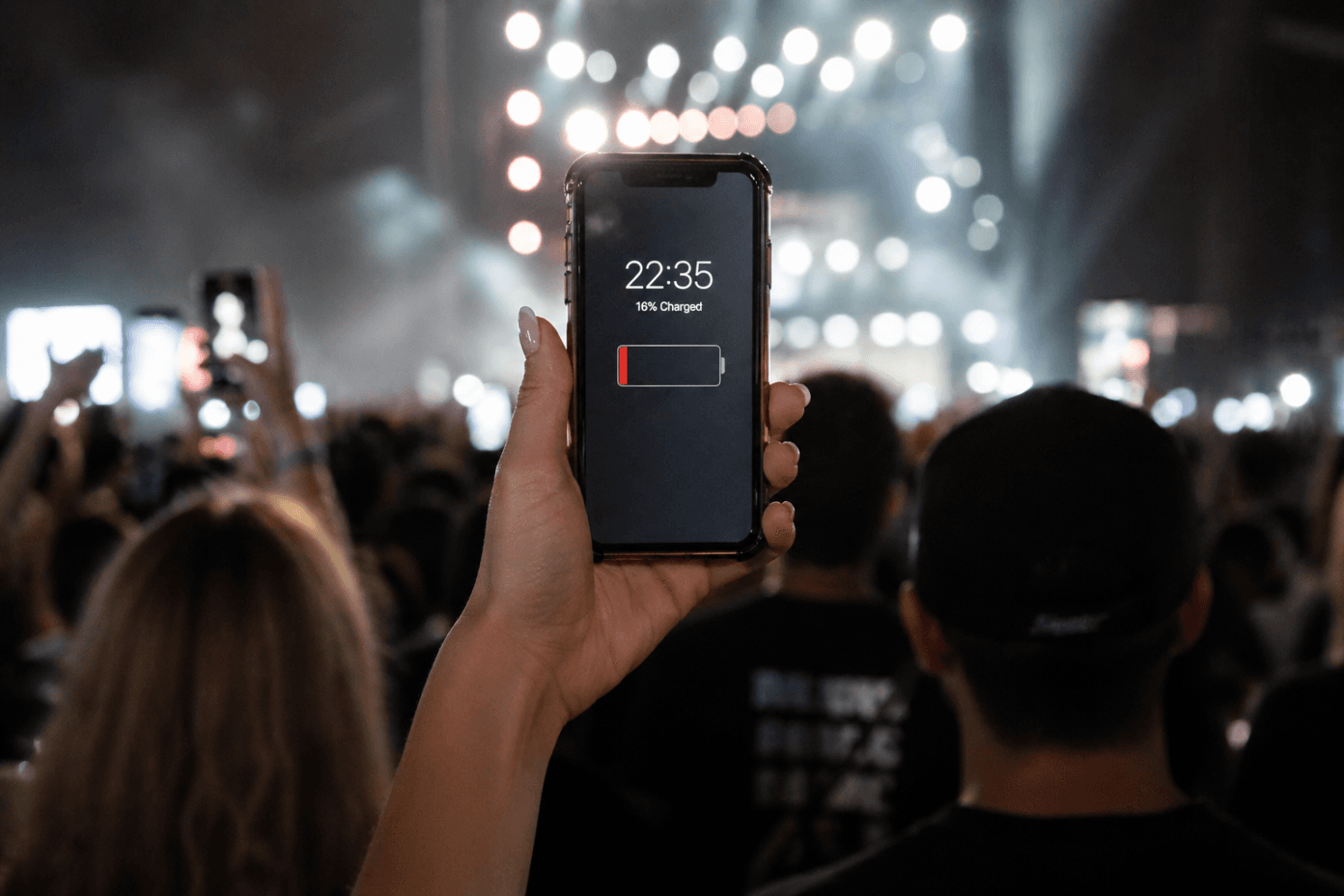
The implications extend beyond convenience. Mobile ticketing systems, cashless payments, and event applications rely on continuous device access, meaning that battery loss can interrupt entry, transactions, and navigation, and affect coordination and communication among attendees (Ticketmaster Sport, 2024). This dependency is particularly pronounced in conference and networking environments, where event applications structure schedules, interactions, and attendee engagement. In these contexts, loss of device access not only disrupts navigation but can also directly limit networking outcomes, reduce participation in scheduled interactions, and weaken the overall value of attendance. (Chen, Jung & Cai, 2025)
In parallel, research highlights a growing safety dimension, particularly within the night-time economy, where a majority of young adults report feeling unsafe when their phone battery is low or depleted, linking device access directly to perceptions of personal security (NTIA & Joos, 2023). For organisers, these conditions introduce friction across engagement, operations, and revenue, as reduced device access limits participation, disrupts transactions, and weakens digital interaction. Within this context, battery availability is no longer peripheral to the event experience, but increasingly embedded within the systems that enable it.
What the Data Actually Shows
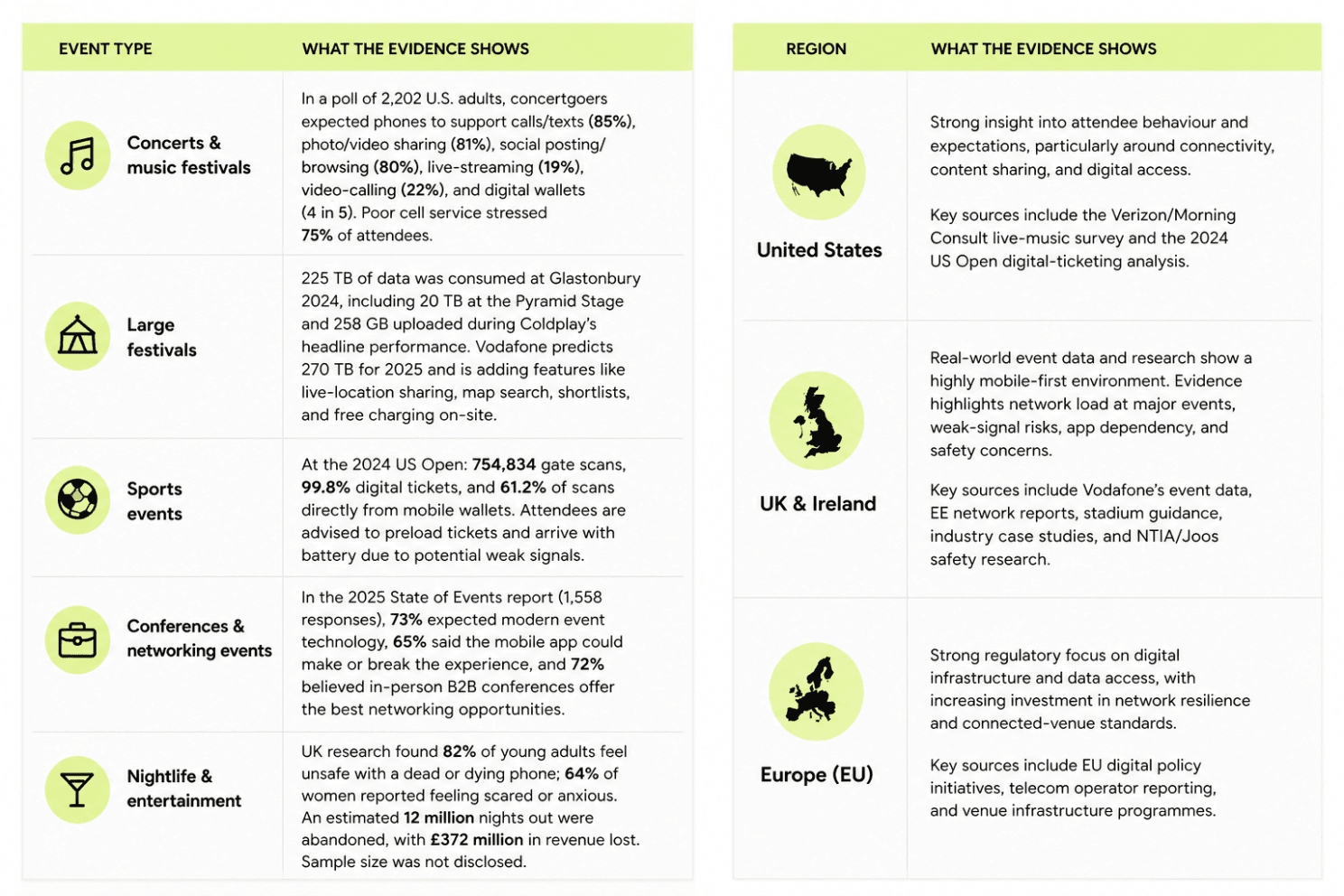
Across surveys, telecom data, ticketing systems, and academic research, a consistent pattern emerges, not across event types, but across shared behaviours. Across all event environments, the pattern is consistent: high dependency, high usage, and a single point of failure.
Why This Happens
At events, battery drain isn’t just about higher usage. It’s about concentrated demand. Devices are pushed to operate across multiple high-intensity functions at once, in environments where the signal is weak, activity is constant, and reliance is continuous. The result is predictable: accelerated battery depletion, followed by immediate friction in access, coordination, and participation.
Behavioural and Business Impact
The immediate user impact is friction. Mobile ticketing has shifted access from physical to digital systems, meaning entry now depends on a functioning device. Research applying innovation resistance theory to mobile ticketing adoption identifies usage barriers, risk barriers, and technological anxiety as key obstacles that are directly activated by device failure or battery loss at the point of entry (Chen, Chang, & Hsiao, 2022).
The same dependency extends into social coordination. Research on mobile media use shows that smartphones increasingly structure how people navigate environments, maintain connections, and coordinate in real time (Ling, 2012). Pew Research data on American attitudes toward mobile phone use in social settings confirms that device presence has become normatively embedded in shared public contexts, with many users reporting discomfort at the prospect of being without their phone (Rainie & Zickuhr, 2015), though this report is about etiquette norms rather than coordination behaviour directly.

In conferences and events, this pattern becomes operational. A critical review of technology-facilitated event engagement finds that mobile accessibility is a primary antecedent of attendee participation, and that perceived accessibility of mobile tools directly shapes willingness to engage, meaning that loss of device access disrupts both interaction and learning, as reviewed in (Chen et al., 2025)
The safety dimension is more acute. A representative survey study on mobile communication and perceived security on public transport found that passengers use mobile phones to establish a sense of social presence, and that this in turn improves felt security, demonstrating a direct link between device access and subjective safety in shared transit and crowd environments (Reichow & Friemel, 2020).

For organisers, the impact extends beyond entry. Research on mobile-driven customer engagement shows that device-mediated behaviour simultaneously spans content consumption, social interaction, and transactional activity, meaning device failure at an event interrupts multiple commercial and communicative channels at once (Kulikovskaja et al., 2023).
Charging infrastructure addresses each of these friction points directly. The following case studies examine what happens when it is treated as a deliberate part of the event experience rather than an afterthought.
Charging ROI and usage metrics
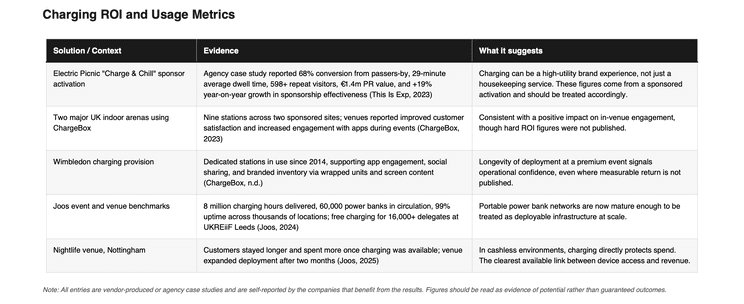
The strongest direct commercial metrics come from sponsor activations rather than neutral operator studies, which means they should be read as evidence of potential rather than guaranteed outcomes. That said, they are persuasive because they measure exactly what event marketers care about: conversion, dwell time, repeat visits, sponsorship effectiveness, and operational ease.
A useful way to separate the commercial value is across three layers.
The first is experience continuity; attendees can still access tickets, maps, wallets, and content. The second is behaviour preservation; they keep networking, posting, scanning, paying, and staying. The third is monetisation charging becomes sponsor inventory, branded utility, dwell-time capture, and in some cases, a paid or revenue-share service. The stronger case studies sit across all three layers simultaneously.
This is the research that informed our decision at pixl Evolution to bring charging infrastructure to live events. Alongside Wayne Madge, who manages our asset operations, and under the leadership of Guy Vellacott, we now deploy charging infrastructure across live events, conferences, and venues, designed to sit across all three layers of value outlined above. If you're running events in 2026, where does charging sit in your planning: afterthought or infrastructure?